Trial of Invasives
Trial of Invasives reflects on the status of a flora declared as foreign and invasive, and therefore undesirable, and to the current tendency it reflects to retreat behind nationalistic patterns.
| Time Frame | 2025 |
| Exhibitions | Gewerbemuseum Winterthur 2026, Kunst Raum Riehen 2026 |
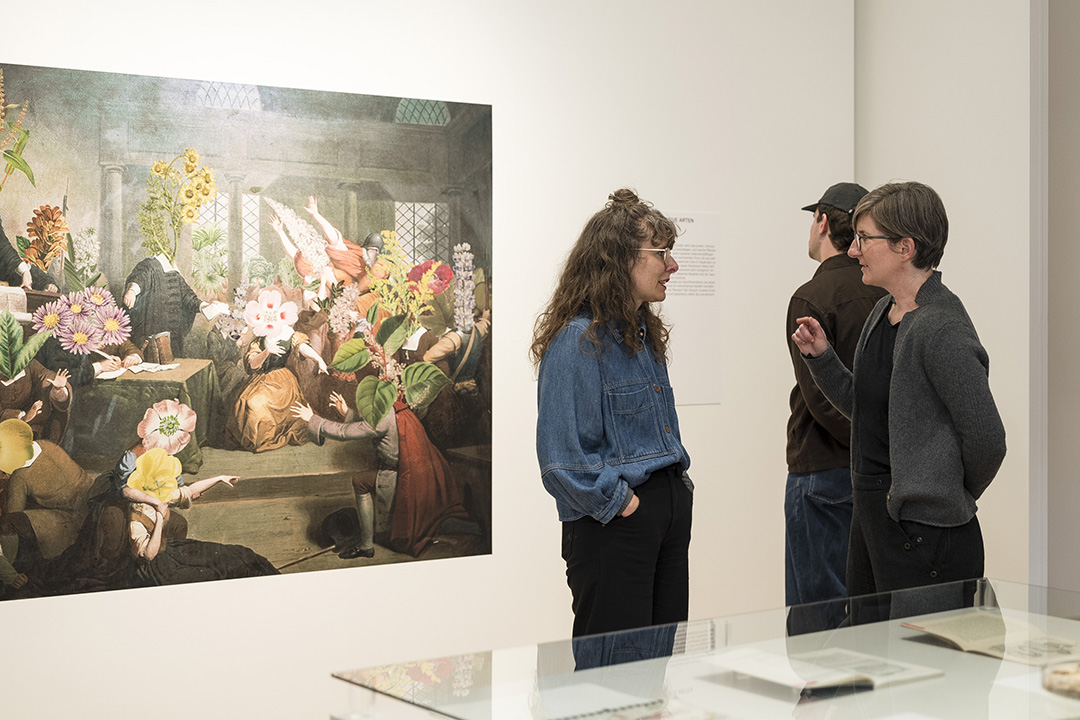
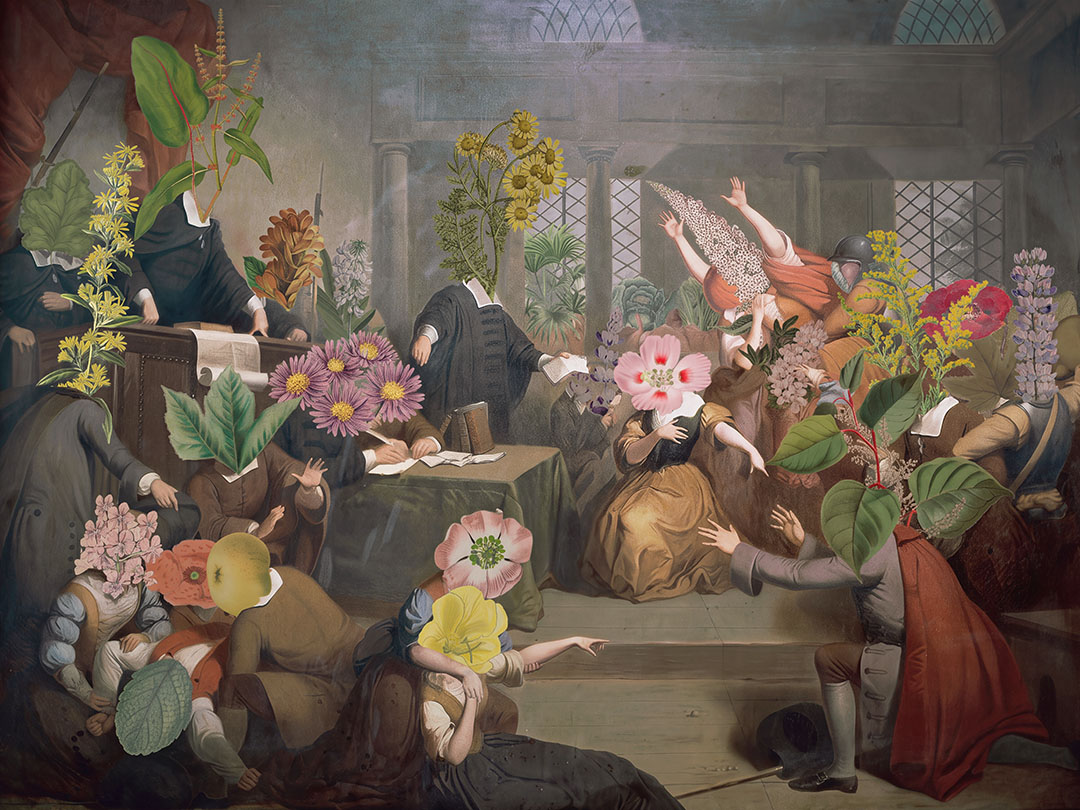
The depicted courtroom scene is rather chaotic: a pink evening primrose (Oenothera speciosa) accuses a Japanese knotweed (Reynoutria japonica) of invasion. Summer lilac (Buddleja davidii) and Canada goldenrod (Solidago canadensis) protest vehemently. On the left of the picture the broad-leaved dock (Rumex obtusifolius) judge and the common ragwort (Jacobaea vulgaris) attorney are both standing in a menacing attitude, while a mint leaf is fainting in the foreground. The crowd in the gallery background, including a Chinese windmill palm (Trachycarpus fortunei), fearfully observes the scene in silence.
Urban flora is flourishing, but this is not regarded positively by everybody: weeds are accused to damage buildings with their roots, other plants are very quickly to propagate thanks to seed dispersal or a highly resistant root network. Some of this spontaneous flora also comes from faraway locations and is labelled as “neophyte” in opposition to the local vegetation which is referred to as “endemic”. A few of those neophyte plants have indeed been very successful to develop in their new human-made habitats and have therefore been labelled as invasive. Nowadays Japanese knotweed is one of the most emblematic invasive neophytes, due to its omnipresence as well as the quasi-indestructibility of its rhizomatic system. But invasion is not a phenomenon reserved to foreign species. Indigenous plants can also become problematic in their own environment, such as the common ragwort which is a common wildflower native to Europe but often unwanted as it can be toxic to cattle and horses, or the broad-leaved dock, a hardy plant that is native to Europe but considered as highly invasive due to abundant seed dispersal, an aggressive root system, and a great adaptation to most climates. There has been in the past some examples of non-human trials, where donkeys and sows have been used as scapegoats of our own human actions. Is something similar happening today with plants?
Digital collage, Céline Baumann, 2025
Based on The Trial of George Jacobs of Salem for Withchraft, painted by Tompkins H. Matteson in 1855.
 Trial of Invasives